AI guidance across US adjudicators.
All 50 states + DC, federal courts, and the major administrative tribunals (EOIR, SSA, VA, PTAB, TTAB, NLRB, EEOC, SEC ALJs, FCC ALJs, FTC, FERC, MSPB) on attorney AI use. Comprehensive: every jurisdiction listed, including those with no formal guidance issued. Per-row "as of" dates and primary-source links. Updated as new guidance issues; if a row is stale, the link is the authoritative version.
- State bar opinions: 21 of 51 jurisdictions (50 states + DC) have issued formal AI ethics guidance. 10 have active task forces or interim recommendations. 20 have no formal opinion as of May 2026. Read §02
- Federal court standing orders are the noisiest layer — hundreds of individual judges have issued orders since Judge Brantley Starr's May 2023 first-mover order. Court-wide standing orders are rare; most are individual-judge. We list representative examples and link to the canonical Bloomberg Law and Law360 trackers for the full corpus. Read §04
- Administrative tribunals are 18 months behind Article III courts. EOIR (immigration) issued the first formal admin-tribunal AI policy in August 2025. USPTO (PTAB / TTAB) had practitioner guidance from April 2024. SSA, VA, NLRB, EEOC, SEC ALJ, FCC ALJ, FTC, FERC, MSPB, FLRA, and Tax Court have no published policies as of May 2026. Read §05
- Cross-jurisdictional pattern: the modal disclosure threshold is "use AI, verify everything, disclose where material." Verification is universal in adopted guidance. Mandatory pre-emptive disclosure is the minority approach. Read §06
- Maintenance contract: every row has its own "as of" date and a primary-source link. If a row is stale, the link is the authoritative version. We update on a monthly cadence. Read §00
How to read this tracker. #
Every row in every table on this page carries (1) a current status, (2) the citation or formal name of the guidance instrument, (3) the date it was issued or, for negative entries, the date we last verified the absence of guidance, and (4) a link to the primary source. The link is always authoritative. If the surrounding text on this page is out of date, follow the link.
The status badges:
- ISSUED — formal opinion, rule, standing order, or policy has been published.
- TASK FORCE — the bar / court / tribunal has formed a task force or working group, but no formal guidance has issued yet.
- INTERNAL — for administrative tribunals: internal-only guidance exists (memos to ALJs, etc.) but no published rule for representatives.
- PROPOSED — rule was proposed but not adopted (typically withdrawn after comment, or pending).
- NO POLICY / NO ORDER / NO FORMAL OP. — we verified that no formal guidance exists as of the date stamp.
This page covers guidance directed at attorneys and representatives, not substantive AI rules directed at primary actors (consumers, employers, registrants). EEOC's AI guidance for employer hiring use of AI, for example, is not on this page; it is a different body of law.
Sources used and methodology. #
This tracker draws from primary sources where available (state bar websites, court orders, agency policy memoranda) and from comprehensive secondary trackers (Bloomberg Law, Law360, Justia 50-state survey, Reed Smith, Goodwin, Wilson Sonsini, ABA, Stanford CodeX RegLab) for confirmation. Where primary and secondary sources conflict, we follow the primary source. Where a secondary tracker reports an opinion we cannot find in the primary source, we mark the row as task force / unconfirmed pending verification.
What is NOT on this page:
- Substantive AI law affecting primary actors (consumer protection, employment discrimination, securities). This page is about practitioner conduct rules.
- Foreign jurisdictions. US federal + state + DC + admin only.
- Continuing legal education resources (CLE catalogues from each state). The bar opinion is the rule; CLE is implementation.
- Vendor-side guidance from AI tool providers. That belongs in the vendor-diligence playbook, not the regulatory tracker.
State bar AI ethics opinions — all 50 states + DC. #
Of 51 jurisdictions (50 states + DC), 21 have issued formal AI ethics guidance, 10 have active task forces or working groups, and 20 have no formal AI-specific guidance as of May 2026. ABA Formal Opinion 512 (July 2024) is treated as persuasive authority in most no-formal-opinion states.
Cross-reference: see A.06 — State Bar AI Opinions: A Comparative Tracker for narrative analysis of the leading opinions and the cross-state pattern. This table is the comprehensive index.
51 jurisdictions tracked. Click a state in the table below to open its full guidance page, or use this dropdown to jump directly.
| Jurisdiction | Status | Citation | Year | Source | Note |
|---|---|---|---|---|---|
| Alabama | NO FORMAL OP. | — | — | www.alabar.org | No formal AI-specific opinion. |
| Alaska | NO FORMAL OP. | — | — | alaskabar.org | No formal AI-specific opinion. |
| Arizona | NO FORMAL OP. | — | — | www.azbar.org | No formal AI-specific opinion. |
| Arkansas | TASK FORCE | Task force | 2024 | www.arkbar.com | Task force established; no formal opinion yet. |
| California | ISSUED | COPRAC Practical Guide + proposed Rule amendments (Mar 2026) | 2023 / 2026 | www.calbar.ca.gov | 2023 Practical Guide. 2026 proposed amendments to Rules 1.1, 1.4, 1.6, 3.3, 5.1, 5.3 (45-day comment period from Mar 13, 2026). |
| Colorado | TASK FORCE | Recommendations exploring | 2024 | www.cobar.org | Recommendations being explored. |
| Connecticut | TASK FORCE | Task force | 2024 | www.ctbar.org | Task force exploring AI ethics issues. |
| Delaware | ISSUED | Sup. Ct. Interim Policy (Oct 21, 2024) + Ch. Ct. cert. requirement (Apr 2025) | 2024 / 2025 | courts.delaware.gov | Court-focused: Sup. Ct. Interim Policy for judicial officers + Court of Chancery practitioner certification requirement (An v. Archblock). No bar ethics opinion. |
| District of Columbia | ISSUED | Ethics Opinion 388 | 2024 | www.dcbar.org | Attorneys' use of generative AI. |
| Florida | ISSUED | Florida Bar Op. 24-1 | January 2024 | www.floridabar.org | Reasonable precautions for confidentiality; oversight policies; reasonable fees; advertising compliance. |
| Georgia | TASK FORCE | Special committee | 2024 | www.gabar.org | Special committee formed; guidance in development. |
| Hawaii | TASK FORCE | Committee | 2024 | www.hsba.org | Committee exploring recommendations. |
| Idaho | NO FORMAL OP. | — | — | isb.idaho.gov | No formal AI-specific opinion. |
| Illinois | TASK FORCE | Initial recommendations | 2024 | www.isba.org | Committee provided initial recommendations; no formal opinion. |
| Indiana | NO FORMAL OP. | — | — | www.inbar.org | No formal AI-specific opinion. |
| Iowa | TASK FORCE | Resource list | 2024 | www.iowabar.org | Resource list provided; no formal opinion. |
| Kansas | NO FORMAL OP. | — | — | www.ksbar.org | No formal AI-specific opinion. |
| Kentucky | ISSUED | KBA E-457 | 2024 | www.kybar.org | Bar association ethics opinion on AI use. |
| Louisiana | ISSUED | La. CCP art. 371(C) (Aug 1, 2025) + Sup. Ct. Letter (Jan 2024) + Tech Commission GenAI Guidelines (Oct 2025) | 2024 / 2025 | www.lsba.org | Civil-law statutory approach. Article 371(C) requires reasonable diligence to verify evidence authenticity. No bar ethics opinion. |
| Maine | NO FORMAL OP. | — | — | www.mebaroverseers.org | No formal AI-specific opinion. |
| Maryland | NO FORMAL OP. | — | — | www.msba.org | No formal AI-specific opinion. |
| Massachusetts | NO FORMAL OP. | — | — | www.massbar.org | No formal AI-specific opinion. |
| Michigan | ISSUED | AI for Attorneys—FAQs | 2024 | www.michbar.org | FAQ-style ethics guidance. |
| Minnesota | ISSUED | AI Working Group Report | 2024 | www.mnbar.org | AI working group report and recommendations. |
| Mississippi | ISSUED | Ethics Opinion 267 | 2024 | www.msbar.org | State ethics opinion on AI. |
| Missouri | ISSUED | Informal Opinion 2024-11 | 2024 | mo.legalethics.us | Informal bar guidance. |
| Montana | NO FORMAL OP. | — | — | www.montanabar.org | No formal AI-specific opinion. |
| Nebraska | NO FORMAL OP. | — | — | www.nebar.com | No formal AI-specific opinion. |
| Nevada | TASK FORCE | Advisory group | 2024 | www.nvbar.org | Advisory group formed; no formal opinion. |
| New Hampshire | ISSUED | Ethics of Using AI in Practice | 2024 | www.nhbar.org | Practice ethics guidance on AI. |
| New Jersey | ISSUED | AI Task Force Report | 2024 | www.njsba.com | Task Force on Artificial Intelligence and the Law report. |
| New Mexico | ISSUED | Formal Opinion 2024-11 | 2024 | www.nmbar.org | Formal ethics advisory opinion on AI. |
| New York | ISSUED | NYSBA Task Force Report (Apr 2024) | 2024 | nysba.org | Comprehensive NYSBA AI report with recommendations. |
| North Carolina | ISSUED | 2024 FEO 1 | 2024 | www.ncbar.gov | AI use in law practice; framed under Rule 5.3 nonlawyer-assistance regime. |
| North Dakota | NO FORMAL OP. | — | — | www.sband.org | No formal AI-specific opinion. |
| Ohio | NO FORMAL OP. | — | — | www.ohiobar.org | No formal AI-specific opinion. |
| Oklahoma | NO FORMAL OP. | — | — | www.okbar.org | No formal AI-specific opinion. |
| Oregon | ISSUED | State Bar Bulletin: The AI Issue | 2024 | www.osbar.org | State Bar Bulletin AI-themed issue. |
| Pennsylvania | ISSUED | Joint Formal Op. 2024-200 | 2024 | www.pabar.org | Joint opinion on ethical issues with AI use; emphasises verification duty. |
| Rhode Island | NO FORMAL OP. | — | — | www.ribar.com | No formal AI-specific opinion. |
| South Carolina | NO FORMAL OP. | — | — | www.scbar.org | No formal AI-specific opinion. |
| South Dakota | NO FORMAL OP. | — | — | www.statebarofsouthdakota.com | No formal AI-specific opinion. |
| Tennessee | TASK FORCE | Task force | 2024 | www.tba.org | Task force exploring recommendations. |
| Texas | ISSUED | TRAIL Interim Report; Op. 705 (Feb 2025) | 2024 / 2025 | www.legalethicstexas.com | Texas Op. 705 (Feb 2025) requires human oversight to prevent fabricated case citations. State Bar Taskforce for Responsible AI in the Law. |
| Utah | ISSUED | ChatGPT Ethical Considerations | 2024 | www.utahbar.org | Guidance on using ChatGPT in legal practice. |
| Vermont | NO FORMAL OP. | — | — | www.vtbar.org | No formal AI-specific opinion. |
| Virginia | ISSUED | Generative AI Guidance | 2024 | www.vsb.org | State Bar guidance on generative AI use. |
| Washington | TASK FORCE | Legal technology task force | 2024 | www.wsba.org | Legal technology task force formed; no formal opinion yet. |
| West Virginia | ISSUED | Op. 24-01 | 2024 | www.wvodc.org | Legal ethics opinion on AI. |
| Wisconsin | NO FORMAL OP. | — | — | www.wisbar.org | No formal AI-specific opinion. |
| Wyoming | NO FORMAL OP. | — | — | www.wyomingbar.org | No formal AI-specific opinion. |
Last verified: . If you find an error, email [email protected].
State court rules and standing orders on AI. #
State courts are slower than state bars to formally regulate practitioner AI use. Where state courts have issued rules, they typically take one of three forms: (a) state-supreme-court-level rule amendments parallel to bar opinions (often adopted after the bar opinion as the operationalization), (b) court-administrative-orders on disclosure and verification (rarer), or (c) individual-judge standing orders in trial courts.
As of May 2026, the cleanest published source for state-court-level AI rules is the Bloomberg Law tracker and the Law360 AI tracker. We do not duplicate their corpus here; we link out for the comprehensive view and call out structural patterns. For a free, openly accessible alternative to the paywalled Bloomberg / Law360 trackers, see also the Ropes & Gray AI Court Order Tracker (550+ orders indexed as of May 2026, with jurisdiction filtering).
States with notable state-court-level AI activity (verified May 2026):
- California — Rule of Court 10.430 requires courts to either ban AI use by judicial officers / research attorneys or adopt a formal AI policy with verification and disclosure requirements.
- Florida — Miami-Dade and Palm Beach County administrative orders require attorneys and self-represented litigants to disclose generative AI use in court filings.
- New York — Multiple individual judges in the Commercial Division have issued AI standing orders; no state-court-wide rule yet.
- Texas — State court AI guidance limited to the bar's TRAIL initiative; individual judges in major counties have begun issuing orders.
Last verified: .
Federal courts — circuits and districts. #
The federal-court layer is the noisiest. Since Judge Brantley Starr (N.D. Tex.) issued the first AI standing order in May 2023, hundreds of individual federal judges have issued their own orders. Court-wide standing orders are rare; individual-judge orders are the norm. The two canonical comprehensive trackers are Bloomberg Law and Law360; both are paywalled.
Circuit-wide guidance (as of May 2026)
| Circuit | Status | Notes | Source |
|---|---|---|---|
| First Circuit | NO ORDER | No circuit-wide AI standing order as of May 2026. | www.ca1.uscourts.gov |
| Second Circuit | NO ORDER | No circuit-wide AI standing order; individual SDNY/EDNY judges have orders. | www.ca2.uscourts.gov |
| Third Circuit | NO ORDER | No circuit-wide AI standing order. | www.ca3.uscourts.gov |
| Fourth Circuit | NO ORDER | No circuit-wide AI standing order; W.D.N.C. has court-wide order requiring AI-use certification. | www.ca4.uscourts.gov |
| Fifth Circuit | PROPOSED | Proposed Local Rule 32.3 (Nov 2023) on AI certification — withdrawn after public comment. | www.ca5.uscourts.gov |
| Sixth Circuit | NO ORDER | No circuit-wide AI standing order. | www.ca6.uscourts.gov |
| Seventh Circuit | NO ORDER | No circuit-wide AI standing order. | www.ca7.uscourts.gov |
| Eighth Circuit | NO ORDER | No circuit-wide AI standing order. | www.ca8.uscourts.gov |
| Ninth Circuit | NO ORDER | No circuit-wide AI standing order. | www.ca9.uscourts.gov |
| Tenth Circuit | NO ORDER | No circuit-wide AI standing order. | www.ca10.uscourts.gov |
| Eleventh Circuit | NO ORDER | No circuit-wide AI standing order. | www.ca11.uscourts.gov |
| D.C. Circuit | NO ORDER | No circuit-wide AI standing order. | www.cadc.uscourts.gov |
| Federal Circuit | NO ORDER | No circuit-wide AI standing order; relevant for PTAB/TTAB appeals. | cafc.uscourts.gov |
Notable individual federal-judge / district-wide orders (representative)
Not exhaustive. Maintained as a representative cross-section of the most-cited orders. The full corpus is in Bloomberg / Law360.
| Judge / District | Date | Note | Source |
|---|---|---|---|
| N.D. Tex. — Judge Brantley Starr | May 30, 2023 | First federal AI standing order. Requires certification that no portion of filing was drafted by generative AI, or that any AI-drafted portion was checked for accuracy. | www.txnd.uscourts.gov |
| E.D. Pa. — Judge Michael Baylson | June 6, 2023 | Standing order requiring disclosure of AI use and verification. | www.paed.uscourts.gov |
| S.D.N.Y. — multiple judges | Various 2023-2025 | Multiple SDNY judges issued post-Mata standing orders on AI verification. | www.nysd.uscourts.gov |
| W.D.N.C. — court-wide | 2024 | Court-wide standing order requiring certification with every brief that AI was not used (or that AI use was disclosed and verified). | www.ncwd.uscourts.gov |
| N.D. Ohio — Judge Christopher Boyko | 2024 | Standing order on generative AI: disclosure, verification, sanctions for non-compliance. | www.ohnd.uscourts.gov |
| E.D. Tex. — Judge J. Daniel Larke | April 9, 2025 | Standing order on AI use; certification required. | coop.txed.uscourts.gov |
| S.D.N.Y. — Judge Jed S. Rakoff | Feb 17, 2026 | United States v. Heppner: Memorandum on attorney-client privilege and work-product over AI logs (substantive ruling, not a standing order, but practitioner-relevant). | www.nysd.uscourts.gov |
Last verified: .
Administrative tribunals — EOIR, SSA, VA, PTAB, TTAB, and the rest. #
Administrative tribunals are 18 months behind Article III courts on AI guidance. The two with formal published policies are EOIR (immigration courts, August 2025) and USPTO (PTAB / TTAB, April 2024). The rest — SSA / OHO disability, VA / BVA, NLRB, EEOC, SEC ALJs, FCC ALJs, FTC, FERC, MSPB, FLRA, Tax Court — have no published practitioner AI policy as of May 2026.
This is the layer practitioners are most exposed on. SSA disability hearings alone exceed the volume of all state and federal civil dockets combined; immigration-court hearings exceed all federal criminal dockets. Both have heavy AI use by counsel and limited regulatory guidance.
| Tribunal | Status | Citation | Date | Source | Note |
|---|---|---|---|---|---|
| EOIR (Executive Office for Immigration Review) — Immigration Courts | ISSUED | OOD PM 25-40 (Aug 8, 2025) | August 8, 2025 | primary source | First public AI policy. No blanket ban, no mandatory disclosure for attorneys. Practitioners face discipline for hallucinated citations or AI-generated inaccuracies. EOIR itself contemplates internal AI use. |
| SSA (Social Security Administration) — OHO disability appeals | INTERNAL | Internal memos (limited public guidance) | — | primary source | Largest US adjudicative body by volume. AI guidance is primarily internal; no published rule for representatives as of May 2026. Watch for OHO chief ALJ guidance. |
| VA / BVA (Board of Veterans' Appeals) | NO POLICY | — | — | primary source | No published AI policy as of May 2026. Representative practice (accredited attorneys + agents) has no formal rule. |
| PTAB (Patent Trial and Appeal Board) — USPTO | ISSUED | USPTO AI Guidance (April 2024) | April 2024 | primary source | USPTO published practitioner AI guidance covering both prosecution and PTAB practice. Verification duty; disclosure where material; supervision per supervisory rules. |
| TTAB (Trademark Trial and Appeal Board) — USPTO | ISSUED | USPTO AI Guidance (April 2024) | April 2024 | primary source | Same USPTO AI guidance applies to TTAB practice as to PTAB. |
| NLRB (National Labor Relations Board) — ALJ proceedings | NO POLICY | — | — | primary source | No published AI policy for representative practice as of May 2026. |
| EEOC (Equal Employment Opportunity Commission) — administrative proceedings | NO POLICY | — | — | primary source | No published AI policy for representative practice as of May 2026. (EEOC has separate guidance for employer AI use under Title VII / ADA, distinct from attorney AI use.) |
| SEC ALJs — Securities and Exchange Commission | NO POLICY | — | — | primary source | No published AI policy for ALJ proceedings or practitioner AI use as of May 2026. Substantive AI guidance for registrants exists separately (Reg AI proposed rule withdrawn 2025). |
| FCC ALJs | NO POLICY | — | — | primary source | No published AI policy as of May 2026. |
| FTC — adjudicative proceedings | NO POLICY | — | — | primary source | No published AI policy for representative practice in FTC adjudication as of May 2026. (FTC enforces consumer-protection AI rules separately, distinct from practitioner AI use.) |
| FERC ALJs | NO POLICY | — | — | primary source | No published AI policy as of May 2026. |
| MSPB (Merit Systems Protection Board) | NO POLICY | — | — | primary source | No published AI policy as of May 2026. |
| FLRA (Federal Labor Relations Authority) | NO POLICY | — | — | primary source | No published AI policy as of May 2026. |
| IRS / Tax Court | NO POLICY | — | — | primary source | No published Tax Court AI rule as of May 2026. Practitioner AI use governed by Circular 230 supervisory provisions. |
Last verified: .
Cross-jurisdictional patterns. #
Reading across all the layers above, four patterns are visible:
- Verification is universal. Every adopted guidance instrument requires attorneys to verify AI-generated authority before submission. Whether expressed as a Rule 11 verification duty (federal courts), a Rule 1.1 / 5.3 competence-and-supervision duty (state bars), or a sui-generis certification (federal-judge standing orders), the bottom line is the same: the lawyer is responsible for the words the AI produced.
- Pre-emptive disclosure is the minority approach. Most guidance does not require pre-emptive disclosure of AI use. Florida Op. 24-1 says disclose where material to billing or costs. Most other state bars don't require disclosure absent client request. Federal-judge standing orders that require certification of AI use or non-use are the most aggressive disclosure regime, and they remain the exception rather than the rule.
- Confidentiality is the high-stakes layer. Every adopted guidance instrument warns about uploading client information to public AI tools. The post-Heppner federal case law has begun to give that warning teeth: Heppner held that public AI submission can defeat privilege. That makes the confidentiality directive in the bar opinions enforceable in collateral litigation, which is a sharp escalation.
- The admin-tribunal gap. The volume-heaviest adjudicative bodies (SSA, immigration, VA) have the least guidance. This is exactly inverted from where practitioner exposure actually lives. Disability appeals and immigration filings are where AI hallucinations show up most often per filing volume, and where formal regulatory infrastructure is thinnest.
If your matter spans state bar + state court + federal court + admin tribunal — the four-layer stack mapped above — IXSOR can help build the unified compliance posture. Fixed-fee, ~1-8 weeks, vendor-agnostic.
If your matter spans multiple jurisdictions. #
Many matters cross divides. A federal civil case in S.D.N.Y. with a state-court appeal to the New York Appellate Division and a related employment matter at EEOC can implicate three different rule regimes. Practical sequence:
- Start with the most restrictive rule that applies. If any tribunal in your matter has a verification-with-certification standing order, comply with it for all filings.
- For confidentiality, default to closed-loop AI tools regardless of forum. The strictest privilege regime in any jurisdiction touching the matter governs your tooling choice.
- For disclosure, comply with the strictest forum-specific rule but do not pre-emptively disclose AI use to forums that do not require it (some clients view broad disclosure as waiving privilege; conserve it for where required).
- Document the AI-use decision tree for the matter file. If a §10(a)(4) challenge or a sanctions motion later turns on what AI use you made, the contemporaneous documentation is the evidence you have.
For arbitration overlays specifically, see A.11 — AI in US Arbitration and A.12 — AI in Arbitration: Practice Playbook for Firms.
Citations and further reading. #
Comprehensive secondary trackers:
- Justia — AI and Attorney Ethics Rules: 50-State Survey (free).
- Steno — Legal AI Rules by State (free).
- Responsible AI in Legal Services (RAILS) — AI Orders Resource.
- Bloomberg Law — Federal Court Judicial Standing Orders on AI (paywalled).
- Law360 — Tracking Federal Judge Orders on AI (paywalled).
- Bloomberg Law — State Legal Ethics Guidance on AI (paywalled).
ABA-level guidance:
- ABA Formal Opinion 512 (July 2024) — the federal anchor for state bar opinions.
IXSOR cross-references:
- A.06 — State Bar AI Opinions: A Comparative Tracker — narrative analysis of leading state opinions.
- A.07 — ABA Formal Opinion 512: An Implementation Playbook.
- A.05 — NC State Bar 2024 FEO 1.
- A.11 — AI in US Arbitration.
- A.12 — AI in Arbitration: Practice Playbook for Firms.
This page is a comprehensive tracker of formal guidance directed at attorneys and representatives on AI use. It is not legal advice, does not establish an attorney-client relationship, and does not predict how any specific bar, court, or tribunal will rule on facts not before it. Per-row "as of" dates document last verification. Primary-source links are authoritative; if a row text disagrees with the linked source, the linked source controls.
Frequently asked questions.
Which US states have issued formal AI ethics opinions for attorneys?
As of May 2026, 21 of 51 jurisdictions (50 states + DC) have issued formal AI ethics guidance: California, Delaware, District of Columbia, Florida, Kentucky, Louisiana, Michigan, Minnesota, Mississippi, Missouri, New Hampshire, New Jersey, New Mexico, New York, North Carolina, Oregon, Pennsylvania, Texas, Utah, Virginia, and West Virginia. 10 jurisdictions have active task forces or working groups. 20 have no formal opinion.
Do federal courts require AI disclosure in filings?
There is no federal court-wide rule. AI standing orders are typically issued at the individual-judge level. Hundreds of federal judges have issued AI standing orders since Judge Brantley Starr (N.D. Tex.) issued the first one in May 2023. The Western District of North Carolina has a court-wide standing order. The 5th Circuit considered and withdrew a proposed circuit-wide AI rule in November 2023.
Which federal administrative tribunals have AI policies?
Two: EOIR (immigration courts) issued OOD Policy Memorandum 25-40 on August 8, 2025; USPTO issued AI guidance for both PTAB and TTAB practice in April 2024. The other 11 major federal admin tribunals tracked here (SSA, VA/BVA, NLRB, EEOC, SEC ALJs, FCC ALJs, FTC, FERC, MSPB, FLRA, Tax Court) have no published practitioner AI policy as of May 2026.
What is the universal compliance baseline if no state-specific AI guidance exists?
ABA Formal Opinion 512 (July 2024) governs as persuasive authority. Verification is universal: every adopted state guidance instrument requires attorneys to verify AI-generated authority before submission. Apply the standard duties under the state Rules of Professional Conduct: competence (Rule 1.1), confidentiality (Rule 1.6), supervision (Rule 5.3), candor toward the tribunal (Rule 3.3).
How often is this tracker updated?
Monthly cadence. Per-row "as of" dates are stamped on every entry. The primary-source links are always authoritative — if a row text disagrees with the linked source, the linked source controls.
About the author.
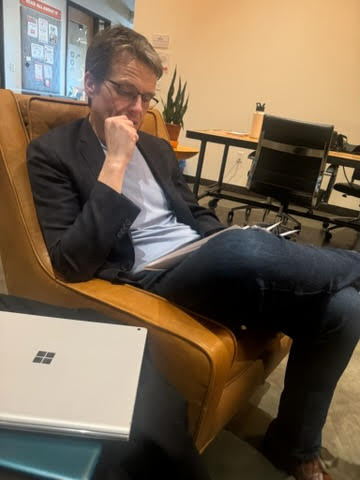
Dan Hughes is the founder of IXSOR. Twenty years in the UK, twenty-five in North Carolina. Ex-BBC. Ex-Apple. Lifelong technologist. And, most importantly: not an attorney. He writes about legal AI from the operational and infrastructure side, where the rules meet the machines. Reach: [email protected]. More by Dan →