EOIR.
Executive Office for Immigration Review (DOJ). First public AI policy from a major federal admin tribunal.
EOIR AI policy status. #
EOIR — the umbrella for the immigration courts and the Board of Immigration Appeals — issued OOD Policy Memorandum 25-40 on August 8, 2025. It is the first formal public AI policy from a major federal administrative tribunal directed at practitioner conduct. There is no blanket ban and no universal mandatory disclosure of AI use, but practitioners face discipline for filings containing hallucinated citations or other inaccurate AI-generated material. Individual immigration judges may impose local rules. Notably, EOIR itself contemplates internal AI use without committing to disclose when an immigration judge's decision has been drafted or influenced by AI — an asymmetry between attorney and agency standards that has drawn commentary.
Authoritative source: https://www.justice.gov/eoir/media/1410621/dl?inline=
Last verified: . If this row text disagrees with the linked source, the source controls.
Why EOIR matters. #
EOIR is one of the highest-volume adjudicative bodies in the United States. The immigration-court backlog exceeds 3 million pending cases as of mid-2026. Per-case representation by immigration attorneys is heavy, and the volume of filings has driven heavy AI use by counsel — making EOIR's 2025 policy the most consequential admin-tribunal AI guidance yet issued. For deportation defense practitioners, AI-related discipline is now a real exposure under EOIR's practitioner-conduct rules.
Practice implications. #
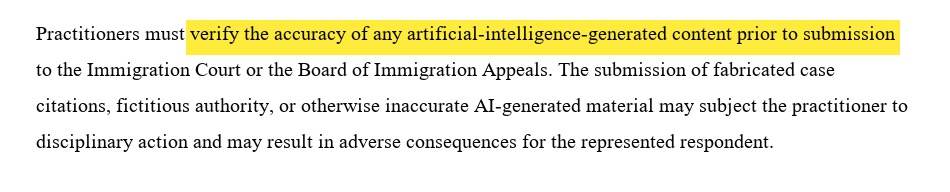
Practitioners appearing before any immigration court or the BIA must verify the accuracy of AI-generated content prior to submission. Hallucinated citations and fictitious authority are explicit grounds for discipline. Local-rule overlays from individual immigration judges may add disclosure or certification requirements. The asymmetry between attorney and agency AI use means practitioners should preserve the issue for any subsequent administrative or federal-court appeal where agency AI use may be relevant.