Louisiana.
Attorney AI ethics guidance status for Louisiana as of May 9, 2026. Statutory + court-rule + supreme-court approach (no bar ethics opinion).
Louisiana bar AI ethics status. #
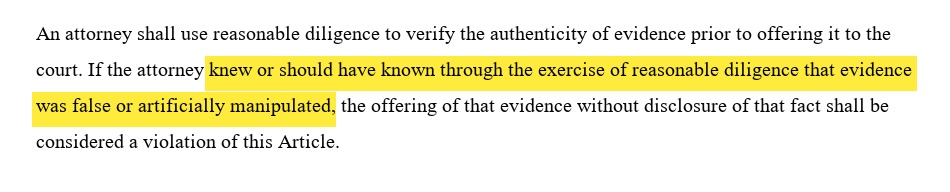
Louisiana's AI guidance is structurally distinctive. Rather than the bar ethics-opinion path most states have taken, Louisiana has used three different mechanisms: (1) a January 22, 2024 Louisiana Supreme Court letter commenting on AI in legal practice; (2) the Louisiana Supreme Court Technology Commission's Generative AI Guidelines (October 2025), aimed at judges; and (3) most importantly, Louisiana Code of Civil Procedure article 371(C), effective August 1, 2025 — statutory language requiring attorneys to use "reasonable diligence" to verify the authenticity of evidence, with a violation if the attorney "knew or should have known" evidence was false or artificially manipulated and offered it without disclosure. The Louisiana State Bar Association has not issued a separate formal ethics opinion on AI; the codified statutory approach is the controlling instrument.
Authoritative source: https://www.lsba.org/NewsArticle.aspx?Article=12b5093a-13ba-407c-b7d9-30057c968c5a
Last verified: . If this row text disagrees with the linked source, the source controls.
What this means in practice. #
For practitioners admitted in Louisiana, the formal guidance above is the binding professional-conduct anchor for AI use. The recurring duties: (1) maintain competence in the AI tool, (2) protect client confidentiality (do not submit confidential material to public-version AI tools), (3) supervise AI output, and (4) verify all factual and legal content before submission.
Cross-jurisdictional consideration: ABA Formal Opinion 512 (July 2024) is broadly consistent with the Louisiana guidance and serves as a federal anchor for multi-state practitioners. Where Louisiana guidance is more specific or more restrictive than ABA Op. 512, the Louisiana guidance controls within Louisiana.
Comparison to ABA Op. 512. #
Louisiana's approach is structurally distinct from every other state. Louisiana is the only US state with a civil-law tradition (rooted in the Napoleonic Code), and that tradition shows in how Louisiana has approached AI: through codified statutory rules rather than common-law-style ethics opinions.
- Louisiana Code of Civil Procedure article 371(C), effective August 1, 2025, is the controlling instrument. It requires "reasonable diligence" to verify the authenticity of evidence before offering it. Knowing or reckless submission of false or AI-manipulated evidence without disclosure is a per se violation. ABA Op. 512 is a guidance document; Article 371(C) is a binding statutory rule with statutory consequence.
- The Louisiana Supreme Court Technology Commission's GenAI Guidelines (October 2025) parallel Delaware's judicial-officer policy — they govern judges and court personnel, not attorneys directly.
- The Louisiana Supreme Court letter (January 22, 2024) signaled that AI does not change existing ethical obligations under the Louisiana Rules of Professional Conduct (which mirror the ABA Model Rules with civil-law modifications).
- No bar ethics opinion. The Louisiana State Bar Association has not issued a formal AI ethics opinion. The codified statutory approach via Article 371(C) is the controlling instrument; bar opinions are not the central regulatory mechanism in Louisiana the way they are in common-law states.
See section 06 below for the civil-law-tradition considerations that apply.
Federal court AI standing orders affecting Louisiana practitioners. #
No widely-noted court-wide or individual-judge AI standing orders affecting Louisiana's federal districts have surfaced as of May 2026. Individual judges may have issued orders that are not in our representative list. Practitioners should consult each assigned judge's standing orders before filing in any federal matter. The comprehensive corpus of federal-judge AI orders is maintained by Bloomberg Law and Law360 (both paywalled).
Last verified: . The comprehensive corpus of federal-judge AI orders is maintained by Bloomberg Law and Law360.
AI case-law context for Louisiana. #
Louisiana sits within the 5th Circuit (United States Court of Appeals for the 5th Circuit). Decisions of the 5th Circuit are binding on the federal courts within Louisiana; state-court decisions of the Louisiana appellate system bind Louisiana's state courts; Supreme Court decisions are binding on everyone. The Supreme Court has not yet issued a decision directly addressing attorney AI use, so the controlling case law is at the circuit and district levels:
N.D. Tex. — issued the FIRST federal AI standing order in the country (May 30, 2023). Requires litigants to file a certificate attesting either that no generative AI was used in any portion of the filing, or that any AI-drafted portion was checked for accuracy by a human being.
E.D. Tex. — standing order requiring AI-use certification on all filings (April 9, 2025).
5th Cir. (Nov. 2023) — proposed circuit-wide AI certification rule, withdrawn after public comment. The withdrawal is itself instructive: the 5th Circuit considered and declined a uniform circuit-wide AI rule.
Practitioners in Louisiana should treat the cases above as the operating framework for AI-related conduct until Louisiana-specific binding precedent or Louisiana bar guidance controls a particular question. The verification duty under Mata and Park v. Kim has been routinely cited in sanctions matters across all federal circuits including the 5th Circuit.
Louisiana legal landscape. #
- Eastern District of Louisiana (E.D. La.)
- Middle District of Louisiana (M.D. La.)
- Western District of Louisiana (W.D. La.)
Louisiana is the only US state with a civil-law tradition (Napoleonic Code derivation). The Louisiana State Bar Association is a mandatory unified bar. Three federal districts. Notable: practice involves civil-law concepts like usufructs, donations, and forced heirship that have no common-law equivalent.
Most US states have adopted the substance of ABA Model Rule 1.1, Comment 8 — that the duty of competence requires lawyers to keep abreast of the benefits and risks of relevant technology. Whether Louisiana has adopted Comment 8 verbatim, in modified form, or relies on the underlying Rule 1.1 text alone, the substantive duty of technological competence applies to AI-related practice in Louisiana.
Louisiana-specific FAQ.
Has the Louisiana bar issued formal AI ethics guidance?
Yes. Louisiana has issued: La. Sup. Ct. Letter (Jan 22, 2024) + Tech Commission GenAI Guidelines (Oct 2025) + La. Code Civ. Proc. art. 371(C) (Aug 1, 2025) (2024 / 2025). The opinion applies the Louisiana Rules of Professional Conduct to attorney AI use. The primary source link in §01 above is authoritative; the comparison to ABA Op. 512 in §03 highlights where Louisiana aligns with or diverges from the ABA framework.
Which federal districts cover Louisiana?
Louisiana has 3 federal districts: Eastern District of Louisiana (E.D. La.), Middle District of Louisiana (M.D. La.), and Western District of Louisiana (W.D. La.). Federal AI standing orders are typically issued at the individual-judge level. The Bloomberg Law and Law360 trackers maintain the comprehensive corpus of federal-judge AI orders nationwide.
Does Louisiana have a mandatory unified bar?
Yes. The Louisiana bar is a mandatory unified bar — all licensed attorneys must be members. AI ethics guidance issued by the bar applies to all admitted practitioners. Discipline for AI-related misconduct flows through the bar's formal disciplinary regime under the Louisiana Supreme Court's plenary supervisory authority.
Does AI vendor diligence apply in Louisiana?
Yes. The supervisory duty under Louisiana's analog to Rule 5.3 (responsibilities regarding nonlawyer assistance) applies to AI vendor relationships. North Carolina's 2024 FEO 1 frames AI vendors explicitly under Rule 5.3, and that framing has been treated as persuasive in other jurisdictions including Louisiana. Vendor diligence — privacy-policy review, data-retention terms, training-on-customer-data clauses — is a precondition to selecting an AI tool for client work.
Why Louisiana is different. #
Louisiana is the only US state with a civil-law tradition. The Louisiana Civil Code and Code of Civil Procedure derive from the Napoleonic Code, not from English common law. This affects every layer of Louisiana legal practice and is showing up distinctively in how Louisiana approaches AI.
- Codified rules over judicial doctrine. Civil-law systems anchor legal obligations in codified statute, with judicial doctrine providing interpretation. Louisiana's primary AI guidance is not a bar ethics opinion (the common-law state pattern); it is Louisiana Code of Civil Procedure article 371(C), a codified statute effective August 1, 2025, requiring "reasonable diligence" to verify the authenticity of evidence. This is binding statutory law with statutory consequence — qualitatively different from a bar guidance document.
- Strong contingent-fee restrictions matter for AI cost-allocation. Louisiana has stricter contingent-fee rules than most states. AI-driven cost reductions in contingent-fee matters require careful Rule 1.5-equivalent analysis under the Louisiana Rules of Professional Conduct, which differ in some specifics from the ABA Model Rules.
- The Louisiana Supreme Court's plenary disciplinary authority is structurally distinct. The Louisiana Supreme Court has direct plenary authority over attorney discipline, channeled through the Office of Disciplinary Counsel. This concentrates regulatory voice in the Court itself rather than in a bar association. The Supreme Court's January 22, 2024 letter and the Technology Commission's October 2025 GenAI Guidelines for judges should be read as authoritative regulatory signals, not advisory.
- Implications for evidence-fabrication risk. Article 371(C)'s "knew or should have known" standard creates a per se violation when AI-fabricated evidence is offered without disclosure. This is a sharper standard than most states' verification-duty framing under Rules 3.3 / 11. Louisiana attorneys offering any evidence whose authenticity they have not personally verified are in statutory exposure even before any disciplinary process begins.