Wisconsin.
Attorney AI ethics guidance status for Wisconsin as of May 9, 2026. No formal AI-specific opinion as of May 2026.
Wisconsin bar AI ethics status. #
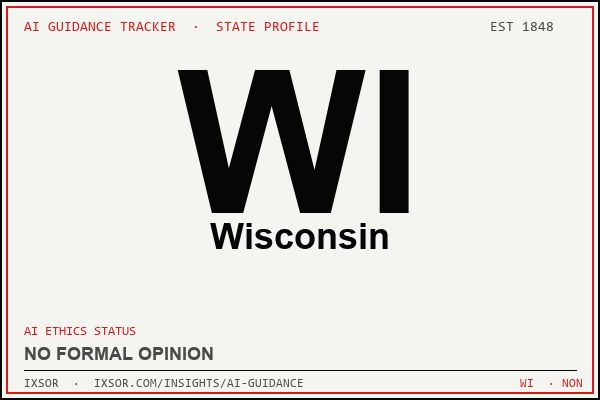
The State Bar of Wisconsin has not issued a formal AI-specific opinion. ABA Op. 512 applies as persuasive authority.
Authoritative source: https://www.wisbar.org/
Last verified: . If this row text disagrees with the linked source, the source controls.
What this means in practice. #
For practitioners admitted in Wisconsin, the absence of a formal Wisconsin-specific AI opinion does not mean AI use is unregulated. ABA Formal Opinion 512 (July 2024) is treated as persuasive authority by Wisconsin as it is in other no-formal-opinion states. The recurring duties under the Wisconsin Rules of Professional Conduct apply to AI use the same way they apply to any other technology: competence (Rule 1.1), confidentiality (Rule 1.6), supervision (Rule 5.3), and candor to the tribunal (Rule 3.3).
Practitioners should treat ABA Op. 512 as the operating reference until Wisconsin-specific guidance issues. Monitor the source link above for updates.
Comparison to ABA Op. 512. #
No state-level opinion exists to compare against ABA Formal Opinion 512 (July 2024). ABA Op. 512 governs as persuasive authority in Wisconsin, applied through the Wisconsin Rules of Professional Conduct (which mirror the ABA Model Rules). The recurring duties imported are: competence (Rule 1.1, including technological competence), communication (Rule 1.4), reasonable fees (Rule 1.5), confidentiality (Rule 1.6), candor toward the tribunal (Rule 3.3), and supervision (Rules 5.1 / 5.3). Practitioners should treat ABA Op. 512 as the operating reference until Wisconsin-specific guidance issues.
Federal court AI standing orders affecting Wisconsin practitioners. #
No widely-noted court-wide or individual-judge AI standing orders affecting Wisconsin's federal districts have surfaced as of May 2026. Individual judges may have issued orders that are not in our representative list. Practitioners should consult each assigned judge's standing orders before filing in any federal matter. The comprehensive corpus of federal-judge AI orders is maintained by Bloomberg Law and Law360 (both paywalled).
Last verified: . The comprehensive corpus of federal-judge AI orders is maintained by Bloomberg Law and Law360.
AI case-law context for Wisconsin. #
Wisconsin sits within the 7th Circuit (United States Court of Appeals for the 7th Circuit). Decisions of the 7th Circuit are binding on the federal courts within Wisconsin; state-court decisions of the Wisconsin appellate system bind Wisconsin's state courts; Supreme Court decisions are binding on everyone. The Supreme Court has not yet issued a decision directly addressing attorney AI use, so the controlling case law is at the circuit and district levels:
N.D. Ill. — among the early federal AI standing orders (2023). Requires disclosure of generative AI use in filings and attorney certification of accuracy.
Mata v. Avianca and Park v. Kim are the most-cited AI sanctions cases in 7th Circuit federal courts.
Practitioners in Wisconsin should treat the cases above as the operating framework for AI-related conduct until Wisconsin-specific binding precedent or Wisconsin bar guidance controls a particular question. The verification duty under Mata and Park v. Kim has been routinely cited in sanctions matters across all federal circuits including the 7th Circuit.
Wisconsin legal landscape. #
- Eastern District of Wisconsin (E.D. Wis.)
- Western District of Wisconsin (W.D. Wis.)
The State Bar of Wisconsin is a mandatory unified bar. Wisconsin is the only US state with diploma privilege: graduates of the University of Wisconsin Law School and Marquette University Law School are admitted to the Wisconsin bar without the bar exam. Two federal districts.
Most US states have adopted the substance of ABA Model Rule 1.1, Comment 8 — that the duty of competence requires lawyers to keep abreast of the benefits and risks of relevant technology. Whether Wisconsin has adopted Comment 8 verbatim, in modified form, or relies on the underlying Rule 1.1 text alone, the substantive duty of technological competence applies to AI-related practice in Wisconsin.
For multi-state practitioners admitted in Wisconsin alongside other jurisdictions, the absence of a Wisconsin-specific opinion means the most-restrictive applicable rule from any admission jurisdiction controls AI-related conduct in the matter. Where ABA Op. 512 conflicts with another state's rule, the lawyer must reconcile the duties under both regimes.
When might Wisconsin issue formal AI guidance? #
Forecast signal: unclear — no announced project.
Mid-sized state bars typically issue 5–15 ethics opinions per year. The Wisconsin ethics committee has not publicly announced an AI work product as of May 2026. A Wisconsin-specific AI ethics opinion is plausible in 2026 or 2027 if AI emerges as a committee priority — but the absence of an announced project as of mid-2026 suggests a timeline of 12–18 months at minimum from the date the committee elects to take up the topic.
What practitioners can watch for, in roughly the order in which they would appear: (1) committee announcement on the Wisconsin bar website that an AI ethics opinion is under consideration; (2) draft circulated for comment (public comment period typically 30–60 days); (3) final approved opinion published in the bar's ethics-opinions index. The transitions from (1) to (3) typically span 4–8 months in active jurisdictions, longer in less active ones.
Until then, practitioners should default to ABA Formal Opinion 512 (July 2024) as the persuasive operating framework, supplemented by the controlling case-law in §05 above and the Wisconsin Rules of Professional Conduct as applied to technology use generally.
Wisconsin-specific FAQ.
Has the Wisconsin bar issued formal AI ethics guidance?
No. As of May 2026, no formal AI-specific opinion has been issued by the Wisconsin bar. ABA Formal Opinion 512 (July 2024) governs as persuasive authority. The Wisconsin Rules of Professional Conduct (competence, confidentiality, supervision, candor) apply to AI-related practice the same way they apply to any other technology.
Which federal districts cover Wisconsin?
Wisconsin has 2 federal districts: Eastern District of Wisconsin (E.D. Wis.) and Western District of Wisconsin (W.D. Wis.). Federal AI standing orders are typically issued at the individual-judge level. The Bloomberg Law and Law360 trackers maintain the comprehensive corpus of federal-judge AI orders nationwide.
Does Wisconsin have a mandatory unified bar?
Yes. The Wisconsin bar is a mandatory unified bar — all licensed attorneys must be members. AI ethics guidance issued by the bar applies to all admitted practitioners. Discipline for AI-related misconduct flows through the bar's formal disciplinary regime under the Wisconsin Supreme Court's plenary supervisory authority.
How should a Wisconsin attorney comply with AI-related ethics rules absent a Wisconsin-specific opinion?
Treat ABA Formal Opinion 512 as the operating reference. Apply the standard duties under the Wisconsin Rules of Professional Conduct: competence (Rule 1.1), confidentiality (Rule 1.6), supervision (Rule 5.3), candor toward the tribunal (Rule 3.3), and reasonableness of fees (Rule 1.5). Verify all AI-generated content before submission. Use closed-loop AI tools (not public consumer-grade) for any matter involving client information.
Does AI vendor diligence apply in Wisconsin?
Yes. The supervisory duty under Wisconsin's analog to Rule 5.3 (responsibilities regarding nonlawyer assistance) applies to AI vendor relationships. North Carolina's 2024 FEO 1 frames AI vendors explicitly under Rule 5.3, and that framing has been treated as persuasive in other jurisdictions including Wisconsin. Vendor diligence — privacy-policy review, data-retention terms, training-on-customer-data clauses — is a precondition to selecting an AI tool for client work.
Why Wisconsin is different. #
Wisconsin is the only US state with diploma privilege: graduates of the University of Wisconsin Law School and Marquette University Law School are admitted to the Wisconsin bar without taking a bar examination. Every other state requires the bar exam (or, in a small number of states, the UBE).
This shapes the AI-regulation question in two ways:
- Bar admission isn't the gatekeeping moment. In states with bar exams, the exam is a quality-assurance checkpoint that catches some forms of unprepared practice. Wisconsin doesn't have that checkpoint for its in-state graduates. The Office of Lawyer Regulation's post-admission supervisory regime carries more of the weight, which makes formal AI ethics guidance from OLR particularly consequential when it issues. As of May 2026, no formal AI opinion has issued.
- Reciprocity considerations. Wisconsin's diploma privilege does not extend to lawyers admitted in other states moving to Wisconsin; those attorneys still must satisfy admission-on-motion or bar-exam requirements. Multi-state practitioners should consult Wisconsin's Supreme Court Rules and the OLR's ethics opinions index for AI-relevant updates.